Production of the Mustang began in Dearborn, Michigan on March 9, 1964 and the car was introduced to the public on April 17, 1964 at the New York World's Fair. It is Ford's third oldest nameplate currently in production. Original sales forecasts projected less than 100,000 units for the first year. This mark was surpassed in three months from rollout. Another 318,000 would be sold during the model year (a record), and in its first eighteen months, more than one million Mustangs were built.
All of these were VIN-identified as 1965 models, but several changes were made at the traditional opening of the new model year (beginning August 1964), including the addition of back-up lights on some models, the introduction of alternators to replace generators, and an upgrade of the V8 engine from 260 cu in to 289 cu in. In the case of at least some six-cylinder Mustangs fitted with the 101 hp 170 cu in Falcon engine, the rush into production included some unusual quirks, such as a horn ring bearing the 'Ford Falcon' logo beneath a trim ring emblazoned with 'Ford Mustang.' These characteristics made enough difference to warrant designation of the 121,538 earlier ones as "1964½" model-year Mustangs, a distinction that has endured with purists.

The 1973 OPEC oil embargo brought with it more stringent pollution laws and the desire for fuel-efficiency. This was also the first time in automotive history that the Big 3 were having to compete with imports. The new Mustang II was smaller than the first version but, due to the additional equipment required to meet new US emission and safety regulations, was heavier than the first model. Performance was reduced and in the first year only 385,993 cars were sold. Second generation Mustangs were available between 1974 and 1978 and available in a coupe and hatchback version.
In 1979 the Mustang was redesigned a third time. This time it was based on the larger Fox platform and the interior was really large enough for four people. The trunk was larger and so was the engine bay. The body styles available included a coupe, hatchback and in 1983 a convertible. In 1979 the Third generation Mustang served as an Indianapolis 500 pace car and Ford built 10,478 commemorative replicas. The third generation Mustangs were produced from 1979 to 1982.

Fourth generation style was available from 1994 to 2004. 1994 Brought about the first major redesign for the Mustang in 15 years. Patrick Schiavone incorporated several styling from earlier Mustangs. The base model came with a 3.8 OHV V6 engine from 1994 to 1998, and was mated to a standard 5-speed manual transmission or optional 4-speed automatic. Though initially used in the 1994 and 1995 Mustang GT, Ford retired the 302 cid pushrod small-block V8 after nearly 40 years of use, replacing it with the newer Modular 4.6 L SOHC V8 in the 1996 Mustang GT. In 1999, the Mustang got a little facelift for both the interior and exterior, but the powertrains remained basically the same.
At the 2004 North American International Auto Show, Ford introduced a completely redesigned Mustang for the 2005 year model. This one was based on an all new platform and the styling was described by Ford's senior vice president of design, J Mays, as "retro-futurism". The base model is powered by a 210 hp cast-iron block 4.0 L SOHC V6. The Mustang GT features an aluminum block 4.6 L SOHC 3-valve Modular V8 with variable camshaft timing (VCT) that produces 300 hp. All 2008 Mustangs have seats containing material derived from soybeans and a new option for the 2009 was the glass roof, which is basically a full sunroof.


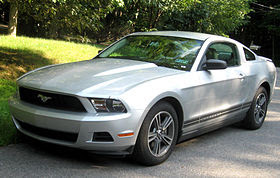
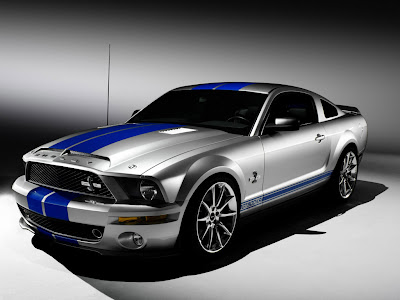
For 2010, Ford unveiled a redesigned Mustang prior to the Los Angeles International Auto Show. The 2010 Mustang remains on the D2C platform and mostly retains the previous-year's drive train options. The Mustang received a thoroughly revised exterior, with only the roof panel being retained, that is sculpted for a leaner, more muscular appearance and better aerodynamic performance. There were 10 models available for the 2010 Mustang. For 2011, Ford revised all the current model engines. The engines feature advanced technologies such as Ti-VCT (twin independent variable cam timing). The Shelby GT500's 5.4L block is now made out of aluminum, instead of iron as in previous years, and is rated at 550 hp and 510 lb•ft of torque. Due to being made of aluminum instead of iron, the new block is 102 lb lighter than the old one, which helps to improve fuel economy, acceleration, handling, and steering precision. All models are available with either a six-speed automatic or manual transmission.